-
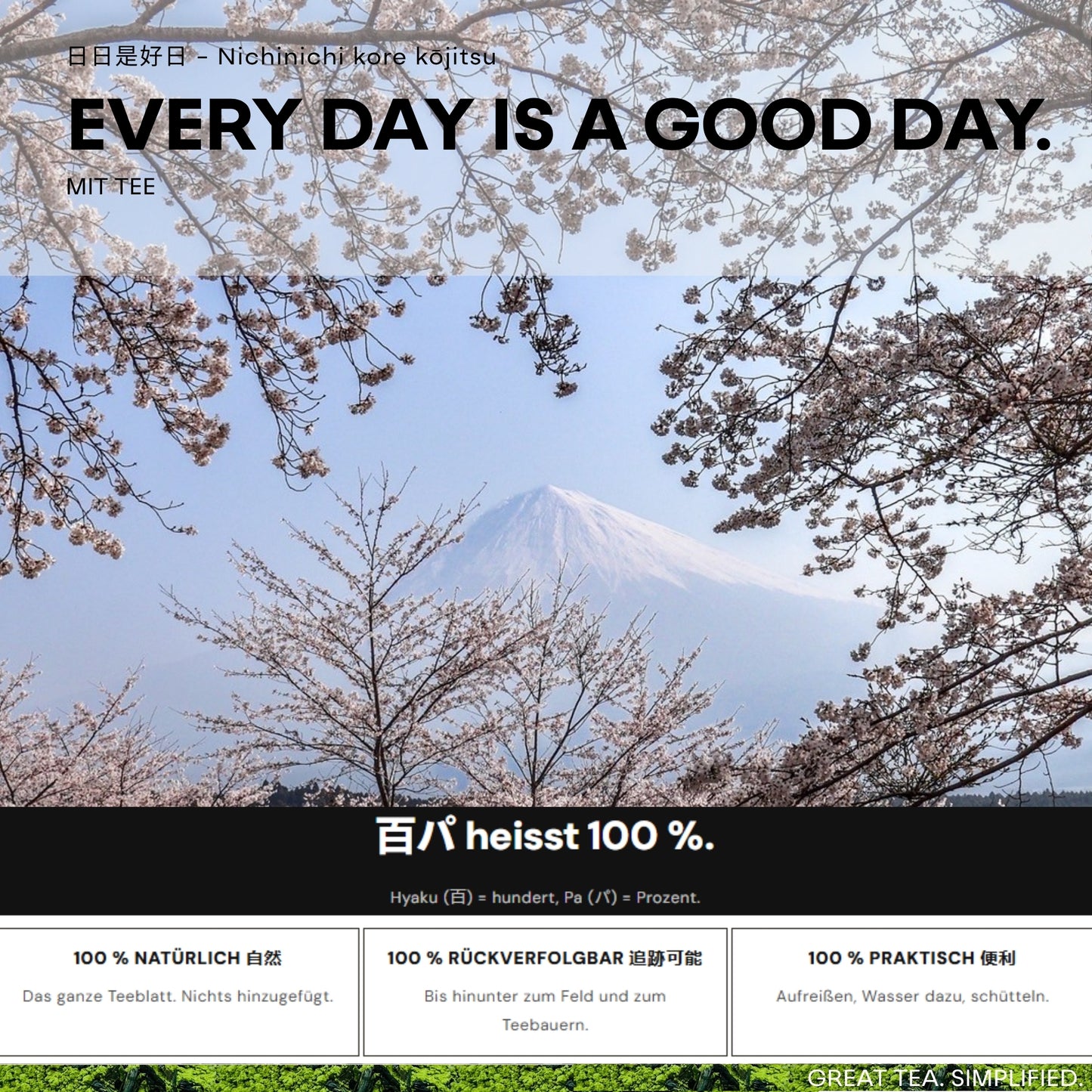
100 % NATURAL 自然
The whole tea leaf. Nothing added.
-
100 % TRACEABLE 追跡可能
Down to the field and the farmer.
-
100 % CONVENIENT 便利
Tear open, add water, shake.
Tear open. Water. Shake.
No chasen. No bowl. 30 seconds — hot or cold. No ceremony required.
ONE TUBE. THREE PORTIONS.
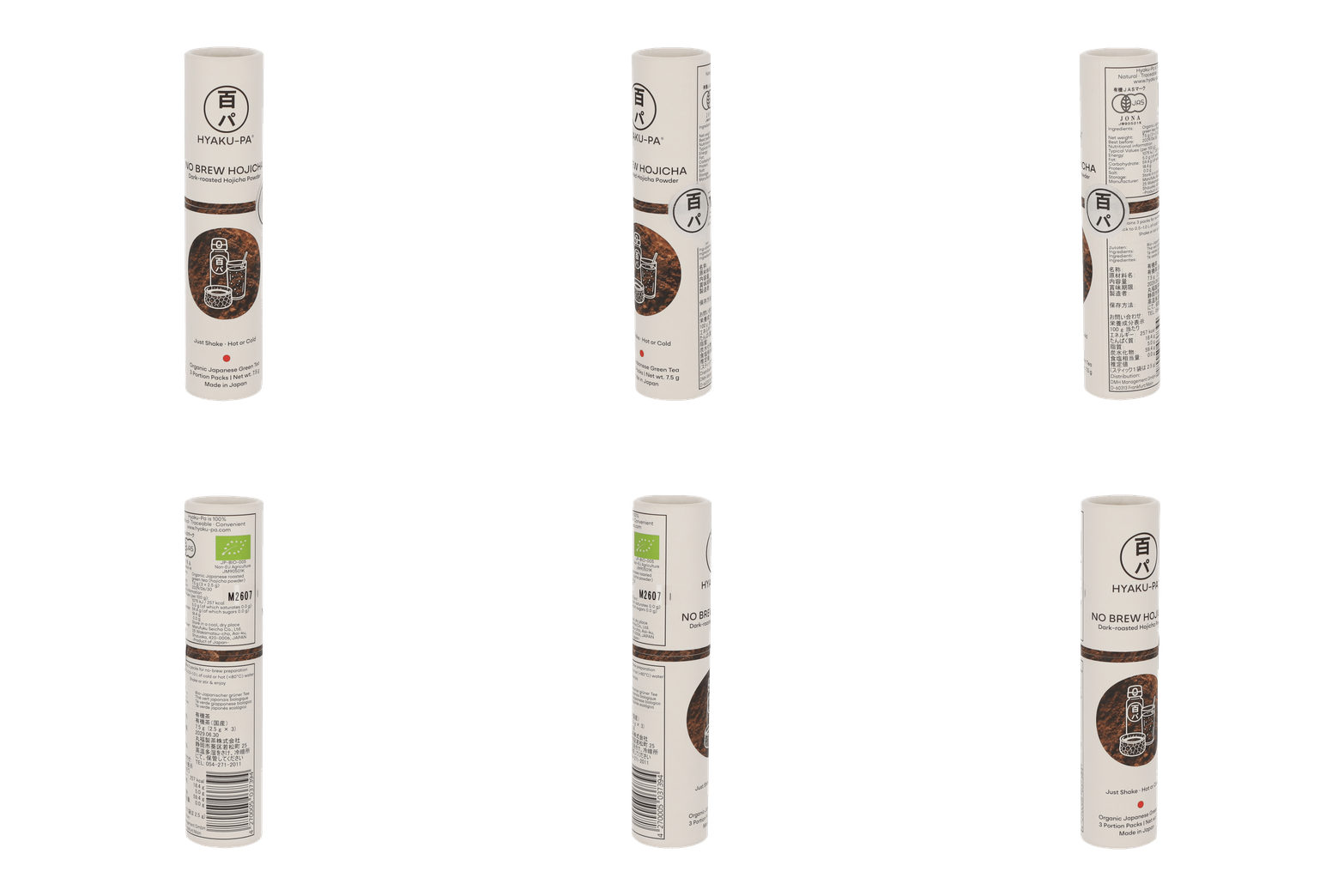
Each tube holds three single portions, one for 0.5–1.0 L of water. Nothing else to buy — water and any bottle or jug will do.
自然 · 100 % NATURAL
BLACK MATCHA — NO SUCH THING.
FIRST HARVEST · TWO CULTIVARS · DARK ROAST
Some call finely ground dark-roasted hojicha "black matcha". Matcha comes from shaded leaf, this does not — but it is just as fine, just as precious, and completely different in taste and effect.
COCOA · ESPRESSO · TOASTED NUTS
Hojicha is usually made from late leaf and stem. This one starts with first-harvest leaf (May 2026), because that is what the roast turns into flavour: those leaves carry the most amino acids, and amino acids plus the leaf's sugars become pyrazines — the cocoa and toasted-nut notes. Dark without going bitter.
Okuhikari — a rare cultivar with limited production, grown in the forested mountains. Handled gently, so the leaf keeps its character.
Yabukita — the classic. Body and sweetness, very little bitterness.
Roasted in Marufuku Seicha's special roaster in Shizuoka, with the oxygen shut out. The whole leaf and nothing added.
No miracle cure — just a very good tea whose effects are well understood.
WHAT IT CONTAINS
Collapsible content
Pyrazines — made in the roaster
Formed when heat brings amino acids and sugars together. They carry the cocoa and toasted-nut aroma and are a large part of why hojicha smells the way it does. Japanese studies suggest the roasted aroma can support the body's rest-and-digest side and peripheral circulation — some of it through smell alone, before the first sip.
Antioxidants — two families
Roasting creates melanoidins — brown compounds with antioxidant activity, formed by the Maillard reaction. It also reduces the catechins the leaf brought in, so hojicha has fewer of them than unroasted green tea. Because the powder is drunk whole, what remains reaches the cup instead of staying in the leaves.
L-theanine and caffeine — the calm side
Roasting costs some theanine. What remains is the amino acid associated with calm attention rather than sedation, and one of the compounds that keep a dark roast round instead of harsh.
追跡可能 · 100 % TRACEABLE
THIS IS THE FIELD. NOT A FIELD.
Two small organic tea gardens in Shizuoka, 15 km apart. Have a look on Google Maps.
OKUHIKARI · AOI-KU → 35°09'21.6"N 138°22'31.3"E
YABUKITA · SHIMIZU-KU → 35°04'36.9"N 138°29'33.0"E
Grown without chemical fertilizers or pesticides — organic fertilizers from rice bran, fish meal and rapeseed meal. JAS/EU organic, residue-tested by Eurofins.
WHAT IT DOES FOR YOU
THREE REASONS.
NO BREW OCHA for energy and focus. NO BREW HOJICHA for wind-down and rest.
No miracle cure — just a very good tea whose effects are well understood.
-
CALM & WIND-DOWN
The roasted aroma helps the nervous system lean toward its resting side. Not sedation — you simply stop feeling wound up.
-
WARMTH & CIRCULATION
Roasted pyrazines are linked to better peripheral circulation; skin temperature at hands and feet can measurably rise. One reason hojicha is a winter tea in Japan.
-
EASY ON THE STOMACH
Roasting breaks down the tannins that make green tea astringent. Almost no bitterness — many people find it noticeably easier to drink, even on an empty stomach.
ANY QUESTIONS?
Collapsible content
Is it bitter?
No. Roasting breaks down the tannins that make green tea astringent — there is no bitterness left to speak of.
How much caffeine is in it?
This harvest came in from the field in May, and the lab analysis is still running. We will publish the exact figure here as soon as we have it. Roasted teas sit well below matcha, but we would rather give you the number for this batch than an average from somewhere else.
How do I prepare it? Can I make a latte?
Tear open one pack, add 0.5–1.0 L of cold or hot water, shake or stir. Thirty seconds. No teapot, no whisk.
For a latte, use 0.3–0.5 L of milk or a plant drink instead of water, cold or warm. The roast carries well against milk.
When should I drink it?
Whenever you like. The roasted taste works at any hour, including the late ones.
Can I drink this instead of coffee?
The aroma will remind you of espresso — the same roasted, dark notes come from the same reaction. What it does to you is the opposite: coffee pushes, this one settles.
What kind of water should I use?
You can use tap water if it is of good quality or bottled mineral water. Soft water with low mineral content, especially low levels of calcium and magnesium, is ideal to bring out the tea’s unique balance of umami, bitterness, and astringency.
How is this different from NO BREW OCHA?
Different tea, different fields, different direction. NO BREW OCHA is (unroasted) matcha and sencha from Shizuoka and Kagoshima — fresh, umami, for the day. This is Okuhikari and Yabukita from two fields in Shizuoka, roasted dark — cocoa and toasted nuts, for winding down. What they share is the Hyaku-Pa standard — natural, traceable, convenient: organic first harvest, whole leaf and nothing else, from a field you can look up, ready in thirty seconds.
Can I return it?
Yes — 30 days. If it isn't for you, send it back and we refund the purchase price. This is on top of your statutory right of withdrawal.
What are scientific sources on the health benefits of tea?
Tea Science Center, University of Shizuoka
Japan’s first comprehensive tea research facility covering production, processing, nutrition, pharmacology, and management.
https://dfns.u-shizuoka-ken.ac.jp/labs/tsc/index.html
National Institute of Fruit Tree and Tea Science (NARO)
Research on tea breeding, production technologies, and health benefits.
https://www.naro.go.jp/english
Harvard T.H. Chan School of Public Health
Studies on health effects of matcha and green tea on brain, heart, and gut health.
Journal of the American Medical Association (JAMA)
Population studies on green tea consumption and cardiovascular health.
Research Center for Kyoto and Tea Culture, Doshisha University
Interdisciplinary research on tea culture and health aspects.
https://research.doshisha.ac.jp
National Center for Biotechnology Information
Provides extensive biomedical literature and research studies including on green tea's health benefits.
MDPI - Publisher of Open Access Journals
Open access scientific journals with peer-reviewed research articles including on tea and health.
Matcha's Power, Explained by Science - Medical Frontiers | NHK WORLD-JAPAN
Popular science explanation of matcha's biological effects by NHK World-Japan. (Video)
-
JAS/EU ORGANIC
-
MADE IN JAPAN
-
QR → FIELD & FARMER
-
FREE SHIPPING OVER €25
-
30-DAY RETURNS