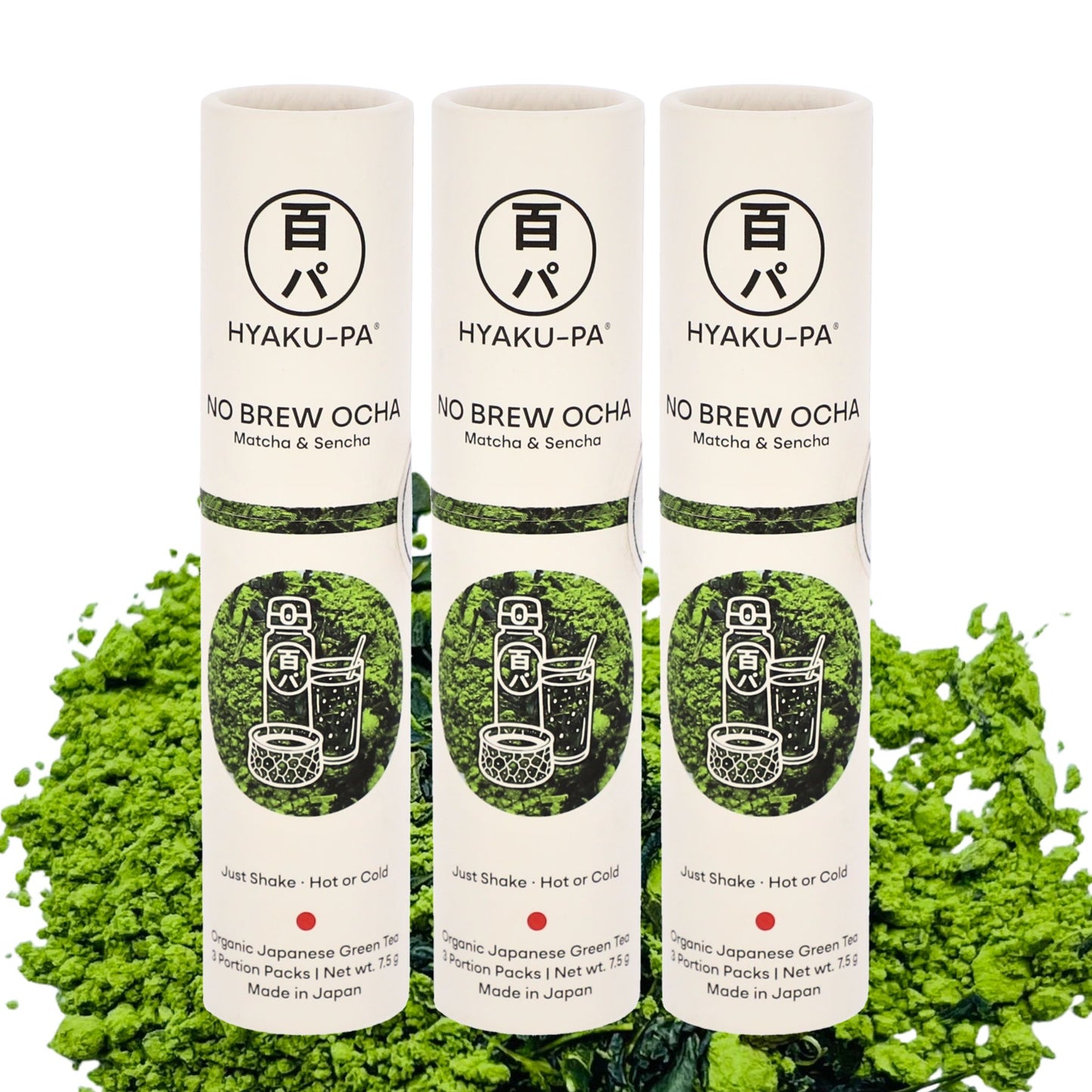
HYAKU-PA 百パ = 100 %

The green tea you shake.

Matcha + sencha, the whole leaf. Awake without the crash — in 30 seconds, hot or cold.

★★★★★ 4.7/5 · 92 reviews Made in Japan

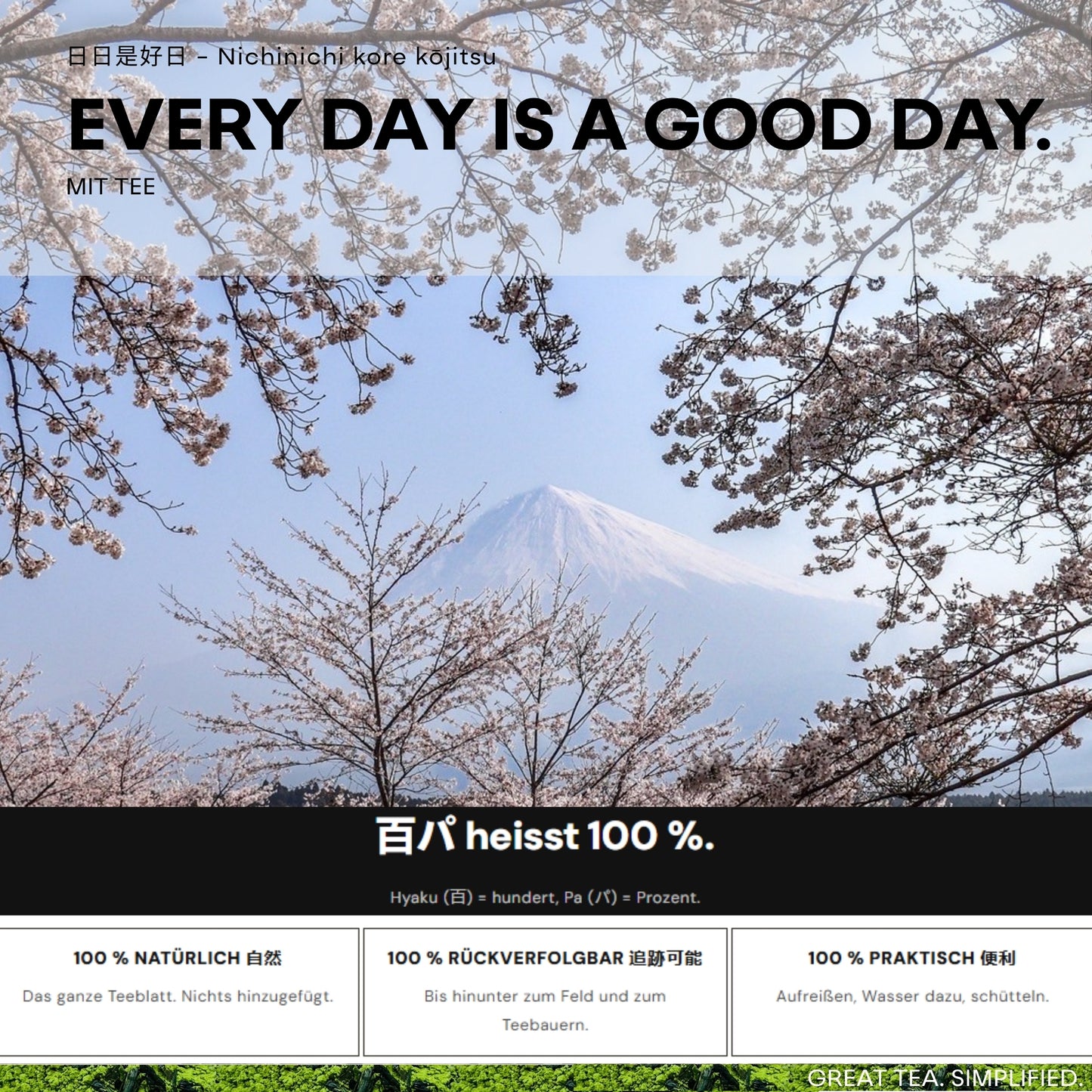
百パ means 100 %.

Hyaku (百) = hundred, Pa (パ) = percent.

  • 100 % NATURAL 自然

    The whole tea leaf. Nothing added.

  • 100 % TRACEABLE 追跡可能

    Down to the field and the farmer.

  • 100 % CONVENIENT 便利

    Tear open, add water, shake.

便利 · 100 % CONVENIENT

Tear open. Water. Shake.

No chasen. No bowl. 30 seconds — hot or cold. No ceremony required.

TEAR OPEN
WATER
SHAKE
100 %!

自然 · 100 % NATURAL

THE WHOLE LEAF. NOTHING ELSE.

80 % MATCHA · 20 % SENCHA · NOTHING ELSE
All the tea's active compounds — nothing left behind in the grounds. Best colour = best quality.

HOW DOES IT TASTE?

80 / 20 MATCHA FOR DEPTH. SENCHA FOR FRESHNESS.

UMAMI-RICH · FRESH · LIGHTLY ASTRINGENT

80 % matcha from a field in the Abe valley in Shizuoka — deep green, clear, rich in umami and sweetness (amami). First harvest, 24 days shaded, stone- and ball-milled.

20 % sencha — deep-steamed Asatsuyu leaves from a field in the Kirishima mountains in Kagoshima, in 3 mm pieces: fresh, sharp, floral.

Composed and blended in Shizuoka.

Colour reflects quality: the greener, the more chlorophyll and theanine. Ours came out greener than every international brand and nearly every Japanese export matcha in a University of Shizuoka panel of 120 teas — rare for organic tea.

CHOOSE YOUR SIZE

No miracle cure — just a very good tea whose effects are well understood.

WHAT IT CONTAINS

Collapsible content

Catechins (EGCG) — Whole leaf antioxidants

Health & Immunity: Provides powerful antioxidant benefits, heart and cell protection, cholesterol control, and immune support.

Performance & Recovery: Enhances endurance by improving mitochondrial efficiency and fat oxidation. Speeds up recovery by reducing exercise-induced oxidative stress and inflammation.

Dental Health: Inhibits cavity-causing Streptococcus mutans bacteria and reduces plaque formation.

Sources: High concentrations of EGCG and Saponins are found in first-harvest, shaded, and stone-milled teas (like Shizuoka matcha and Kirishima Asatsuyu).

L-Theanine — Buffers caffeine, calm focus

Mental Clarity: Umami-rich theanine and GABA promote relaxation, mental clarity, and calming neurological effects, naturally buffering caffeine for a smooth, balanced energy boost without the crash.

Performance & Recovery: Improves athletic focus, increases power output and reaction time, and reduces perceived exertion.

Rest: Aids post-exercise recovery by lowering cortisol levels and improving sleep quality.

Chlorophyll & Dietary Fiber — Only when consuming the leaf

Gut Health & Digestion: Soluble and insoluble fibers regulate glucose, improve gut motility, and promote satiety, while preserving energy availability during physical exertion.

Detox & Oxygen: Chlorophyll provides vibrant color, aids in detoxification, and improves oxygen utilization while reducing oxidative stress during exercise.

Dental Health: Stimulates saliva flow to neutralize acids and utilizes antimicrobial properties to reduce oral bacteria and bad breath.

Vitamins C, E, B & Beta-Carotene

Cellular Support: Delivers comprehensive antioxidant and immune support: Vitamin C (highest in steamed sencha), cell-protecting Vitamin E, energy-metabolizing B vitamins, and Beta-carotene (Vitamin A precursor).

Performance & Recovery: Supports ATP energy production, boosts endurance, and aids in post-workout muscle and tissue repair.

Dental Health: Promotes gum integrity and helps reduce periodontal inflammation.

追跡可能 · 100 % TRACEABLE

THIS IS THE FIELD. NOT A FIELD.

Two small organic tea gardens in Japan. Have a look on Google Maps.

MATCHA · SHIZUOKA → 35.049833, 138.350694

SENCHA · KAGOSHIMA → 31.889556, 130.754722

Certified Organic Japanese Agriculture

WHAT IT DOES FOR YOU

THREE REASONS.

No miracle cure — just a very good tea whose effects are well understood.

  • HEALTH & LONGEVITY

    Catechins, polyphenols and minerals — from the whole leaf, not from the infusion.

  • ENERGY & FOCUS

    Caffeine like a cup of coffee, buffered by L-theanine: calm, not jittery.

  • EXERCISE & RECOVERY

    Energy before, antioxidants after — by the litre.

  • ★★★★★ „I don't take anything else onto the court anymore."

    Sophia Jurina · Tennis player & model

  • ★★★★★ „Look at that colour — that's your pilates upgrade."

    Annalena · Pilates creator

CHOOSE YOUR SIZE

FOR THE ROAD OR FOR HOME.

1 of 5

ANY QUESTIONS?

Collapsible content

Does it taste bitter or grassy?

Neither. Most people who say green tea tastes bitter or grassy have had old, coarsely ground, low-grade powder — those words describe that, not this. Ours tastes fresh, clear and crisp: umami and amami, a full rounded sweetness, with just enough kire, the clean edge that makes it thirst-quenching instead of heavy.


How much caffeine is in it?

The powder is 2.5 to 3 % caffeine — around 60 to 75 mg per 2.5 g portion, about as much as an espresso. And since you drink the whole leaf, the L-theanine comes with it: awake without the crash.

How do I prepare HYAKU-PA NO BREW OCHA?

Each tube contains three portion-packs for no-brew preparation.

Add pack to 0.5-1.0 L of cold or hot (<80°C) water, shake or stir & enjoy.

See video.

Can I drink the small leaf pieces?

Yes — that's the point. You drink the whole leaf instead of throwing it away, including its dietary fibre. The matcha dissolves completely; the 3 mm sencha pieces stay visible and settle at the bottom. Shake again, or leave them — or eat them afterwards with a little soy sauce, as tea farmers do.

What kind of water should I use?

You can use tap water if it is of good quality or bottled mineral water. Soft water with low mineral content, especially low levels of calcium and magnesium, is ideal to bring out the tea’s unique balance of umami, bitterness, and astringency.

Can I return it?

Yes — 30 days. If it isn't for you, send it back and we refund the purchase price. This is on top of your statutory right of withdrawal.

What are scientific sources on the health benefits of tea?

Tea Science Center, University of Shizuoka

Japan’s first comprehensive tea research facility covering production, processing, nutrition, pharmacology, and management.

https://dfns.u-shizuoka-ken.ac.jp/labs/tsc/index.html

National Institute of Fruit Tree and Tea Science (NARO)

Research on tea breeding, production technologies, and health benefits.

https://www.naro.go.jp/english

Harvard T.H. Chan School of Public Health

Studies on health effects of matcha and green tea on brain, heart, and gut health.

https://www.hsph.harvard.edu

Journal of the American Medical Association (JAMA)

Population studies on green tea consumption and cardiovascular health.

https://jamanetwork.com

Research Center for Kyoto and Tea Culture, Doshisha University

Interdisciplinary research on tea culture and health aspects.

https://research.doshisha.ac.jp

National Center for Biotechnology Information

Provides extensive biomedical literature and research studies including on green tea's health benefits.

https://www.ncbi.nlm.nih.gov/

MDPI - Publisher of Open Access Journals

Open access scientific journals with peer-reviewed research articles including on tea and health.

https://www.mdpi.com/

Matcha's Power, Explained by Science - Medical Frontiers | NHK WORLD-JAPAN

Popular science explanation of matcha's biological effects by NHK World-Japan. (Video)

https://www3.nhk.or.jp/nhkworld/en/shows/2050179/

  • ★ 4.7/5 · 92

  • JAS/EU ORGANIC

  • MADE IN JAPAN

  • QR → FIELD & FARMER

  • FREE SHIPPING OVER €25

  • 30-DAY RETURNS